Thursday, April 19, 2012

The Writer's Craft: Learning From Failure


I’ve always been more intrigued by questions than answers, and I find the fluteplayer image painted or carved on cliff walls throughout the Americas (but most famously here in the Southwest) particularly evocative. Is the fluteplayer a traveling salesman, a supernatural being, or a specific individual? Does he symbolize fertility, rain, seeds, music, or a particular ceremony? 

Fluteplayer pictograph near Sedona, Arizona
I had a lot of time to contemplate these questions while acting as a volunteer docent at Palatki, near Sedona, leading tours of alcoves containing centuries of rock art. One afternoon, a set of possibilities magically shaped themselves into a children’s tale. Thus far, it is the only time in my writing life that I felt visited by a muse. I decided that destiny was playing its hand, and a couple weeks later I sent off the completed manuscript for Kokopelli’s Gift expecting great things: a major publisher, a fat advance, tons of sales, maybe even tie-in products like notecards or refrigerator magnets or, heck, why not a Kokopelli stuffed toy?

The manuscript limped back, rejected.

As the saying goes, this wasn’t my first rodeo, so I knew that I needed to detach, reprint, package, stamp, and send it to the next publisher on the list. And the next. And the next. And the next.

All tolled, I queried and pitched dozens of publishing companies, coming close only once before the book finally found a home at Kiva Publishing, a small company in California that specializes in Southwest-themed books. Owner/publisher Stephen Hill had a talent for matching up writers and illustrators, and he contracted a gifted artist from New Mexico's Santa Clara Pueblo, Michelle Tsosie Sisneros, to illustrate my story about a mysterious stranger who visited a drought-stricken village.

Though I’d expected fireworks from Kokopelli’s Gift, I received instead a small but steady flame that still burns. My articles and guidebooks have been ephemeral—useful to travelers I’m happy to say, but out-of-date in a month, a year, five years, whisked away by rack-jobbers or replaced by new editions. What pleases me most about Kokopelli’s Gift is that it's beautiful (thank you, Stephen and Michelle), and it endures (thank you, muse).

I might have given up on this story after the first round of rejection letters, but I once knew a novelist who sold a Gothic romance twenty years after writing the manuscript, when Gothic fiction resurged in popularity. The obvious moral is “never give up.” In other words, be committed. But there’s an equally important corollary to this moral: Don’t mistake attachment for commitment.

If you’re attached to your story, you may not make necessary revisions, or you may resist tailoring it to a publisher's needs. If you’re attached to a particular outcome—being published, getting a six-figure advance—a sense of failure is likely after a few tries or a few years, and you’ll probably throw in the towel.

But how can you be committed and detached at the same time? 

For most of us, this is one of life’s greatest questions, and there’s no easy answer. Like an archaeologist searching for the past, you may need to dig deep to uncover the origins of your attachment. My attachments, I’ve found, are often responses to feelings of lack or fear. When you’re able to bring up an attachment and look at it in the hard, bright light of day, you can begin to free yourself. Then, with renewed insight, you can commit to your progress as a writer.

Sunday, April 15, 2012

Flowers in the Desert


Poppies and phaecelia  in the Sonoran Desert

Spring brings improbable splashes of color to the rocky deserts of California, Nevada, and Arizona. Something about flowers blooming in an arid landscape calls to the human psyche. Photographers and travelers hoping for an iconic scene dial hotlines or check websites for wildflower reports. (Desert USA is a superb resource.) Gorgeous coffee table books by Larry Ulrich or Jack Dykinga get snapped up along with wildflower field guides. Many of us bring home seed packets, hoping to replicate Mother Nature’s annual surprise party in our own backyards.

What is it about flowers in the desert that speaks to us so? Certainly, they are a metaphor for perseverance. Or for finding beauty in unexpected places—a swath of golden poppies at the base of a rocky peak, a red plume of Indian paintbrush bursting from a split boulder. A flower in the desert also reminds us of the ephemeral nature of beauty and youth: Here today, dried sticks tomorrow.

Speaking from a writer’s standpoint, I think that the vision of a tender plant surrounded by cacti, dirt, and rocks creates a feeling of tension. It’s like starting a story in medias res (in the middle of the action), intriguing the reader with questions: How did this get here? What happens next? There’s a sense of impending doom, for you know this delicate flower won’t survive the harsh desert summer.

Or will it?

What I’m getting at in a roundabout way is that all types of writing, even nonfiction, can incorporate fiction-writing techniques to pique the reader’s interest or simply to entertain. Though I haven’t written poetry in many years, I still think about rhythm, consonance, alliteration, and other poetic techniques when I write travel pieces. Similarly, I’ve found that the ingredients of a compelling novel—tension, conflict, characterization, sensuality—often work well for nonfiction.

Maybe you’re writing a piece about an upcoming city council meeting, or a blog post about using Facebook for marketing. As you re-read the draft of your article, think of the wildflower in the desert that makes you stop and take a closer look. Have you unconsciously incorporated storytelling techniques in your work? Will readers feel compelled to stop and take another look themselves? Will they ask, "What happens next?" 

Thursday, April 12, 2012

Take a Hike: Long Canyon, Sedona


Overlooking Long Canyon, Sedona, AZ
I have a soft spot for Long Canyon, located about four miles northwest of Uptown Sedona as the raven flies. A story about hiking the canyon was the very first piece I sold to Arizona Highways magazine, back in 1999. But Long Canyon was one of my favorite places way before then, with its deep shade, candy-striped cliffs, giant manzanitas, and entertaining bird life.

Decades ago Long Canyon was a hideout for bootleggers. (Some well-meaning but misguided hikers removed the bootleggers' “trash” a few years back, so that bit of the past has been erased for history buffs and archaeologists.) Today, the canyon is a great place to hide out from the bustling shops and galleries in Sedona, offering a change of scenery, a moderate hike, and a breath of fresh air.

The Long Canyon Trail starts at an unpaved parking area off Forest Road 152D and leads through manzanita, scrub oak, and junipers as it gently climbs toward deeper forest. Ponderosa and piƱon grow beside Long Wash, and after snowy winters, the musical notes of flowing water echo off the surrounding cliffs. The tall trees play peekaboo with the views as the trail continues to climb, ending at about four miles.

At certain times of the year, the last mile of trail can be obscured by snow or lined with a gauntlet of poison ivy, so I prefer to approach Long Canyon without an agenda. You don't have to hike to the end of the trail to find beautiful places to linger—a sandstone arch, a wide tributary scattered with rocks and pinecones, a cliffside perch perfect for watching the antics of Stellar jays and acorn woodpeckers.

Other than poison ivy, Long Canyon has only two drawbacks: tour helicopters that buzz overhead with annoying frequency on busy weekends and the Seven Canyons golf resort, which sprawls near the canyon entrance as out of place as, well, green grass in a desert.

Even so, the canyon remains one of the wildest places within a few minutes of Sedona. Here, it’s easy to imagine a mountain lion blending into the buff-colored Coconino sandstone cliffs high above, or a black bear nosing a mossy fallen pine. The last few miles of the Long Canyon Trail lie within the Sedona–Red Rock Wilderness Area, but mountain bikers can turn off the main trail for Deadman Pass, outside wilderness boundaries and scenic in its own way.

People occasionally ask why I write about Sedona’s hidden places instead of keeping them to myself. I believe that when I introduce someone to this wild beauty (especially someone who’s never hiked a wilderness before) that person becomes a potential defender of natural places. Yes, I'm hoping to recruit an army of tree-huggers.


For those who have already been transformed by the outdoors, stay tuned: I'll be writing about a hike or two every month.


Sunday, April 8, 2012

The Writer's Craft: Spring Cleaning


George Orwell once said, “Good prose is like a windowpane.” Getting your prose to that state of clarity is, of course, not as simple as it sounds. Maybe that’s why Orwell also said, “Writing a book is a horrible, exhausting struggle, like a bout of some painful illness.”

Though spring is associated with fresh starts, writers need to polish and prune all year long. A few quick tips at making every word count:

Organize. Take a metaphoric step back and look at structure. Rearrange or toss out words, sentences, and even entire paragraphs that don’t support your story. If you’re in love with a section that simply doesn’t fit but you can’t bear to trash it, save it in a “Cuts” folder. Chances are you’ll never miss it and never return to it … but it’s there just in case you want to try it on for a different project.

Lose the deadwood. Can you say the same thing in fewer words? Helper verbs (was, been, have, could, does, etc.) aren’t always helpful. Take a closer look. Maybe you can even trim a letter here and there. (“Toward” is better than “towards.”)

Go for more color. Cut back on nonspecific verbs like “went” and aim for something better suited to character, setting, or story, like “raced” or “dawdled.” Trade in vague constructions like “There are” for something more pointed.

Retrain. Look for overused words or lazy habits. Make a list of your usual suspects and search them out. (Use your word processor’s Find feature if necessary.) Eventually you’ll recognize the offenders as you’re typing and replace them automatically.

Tweak, trim, and repeat until your prose sparkles. Self-editing is a skill that can be acquired through practice or with the help of a style guide. A classic is Strunk and White's The Elements of Style.


Thursday, April 5, 2012

Which writer are you?


Everyone’s a writer, or at least it seems that way these days. Blogs, Facebook posts, e-newsletters, self-published books…. I could go on, but for someone like me who’s old enough to remember how thrilling it was to break into print (i.e., ink on actual pages) and who’s still dreaming of writing a hardcover bestseller—well, the new reality can be a bit disconcerting.

I feel a bit like a traveler who suddenly realizes she’s hopelessly lost. But years of traveling have taught me that getting lost sometimes leads to great discoveries. First, I needed to discover—or uncover—what kind of writer I am. Or, in other words, who have I been all these years?

I’m not an artist. Some writers are. Terry Tempest Williams comes to mind. For me, her evocative prose triggers a spectrum of senses and emotions, and the visual images inspired by her writing linger long after reading. To reach out and touch someone … that’s art.

And I’m not a storyteller (but how I wish I were!): the writer who keeps you up past your bedtime so that you can read just one more page. Paragraph. Chapter. (Oh, wait—is that the sun coming up already?) Nora Roberts, John Grisham, Diana Gabaldon, Val McDermid…. I bet you have a list of favorites too.

Me, I’m more of a bricklayer: A blue-collar writer who approaches writing as a skill more than an art, as a job more than a calling. My dad was a union carpenter, and like him, I go to work every day and apply my skills to different projects. He helped build bridges or buildings. I’ve written novels and articles, press releases and brochures, technical manuals and poetry. I’ve worked for publishers, businesses, a film producer, and even other authors. And when writing gigs were thin on the ground, I took second jobs to learn more (proofreading, editing, page layout) or to earn more (retail, teaching yoga, housecleaning).

Many people think of writing as a purely creative pursuit. I agree in one sense: You have to be creative at how you pursue writing if you want to make it a bigger part of your life. If I waited for the muse to strike, most days, I’d just be sitting here. Waiting.

I prefer to think of writing as a craft. Tools, mentors, experience, luck, inspiration, hard work—take these “bricks” and over time you can build something that looks a lot like a career. Travel writer and bricklayer, that’s me. Now that I’ve settled the question of who, it’s a question of how. And why. Did I choose travel writing, or did it choose me?

Since the “hows” are pretty straightforward, I’ll start with those, in between writing about what I like best: traveling.

Sunday, April 1, 2012

Sedona Vortex Sites

Airport Saddle vortex
Now that I’ve mentioned Sedona’s famous (or infamous) energy vortex sites once or twice, it’s time to go into further detail. And no, this has nothing to do with April Fool’s Day!

Right now, you may be blissfully unaware of the mysteries of vortices (plural for vortex). But if you visit Sedona, you’ll encounter scores of vortex-related books, souvenirs, tours and—if you’re fortunate—even a vortex or two. Among locals, there are as many skeptics as believers, so the best thing to do is keep an open mind and decide for yourself. Is the vortex phenomenon real, or—as a dear friend claims—is the only vortex in Sedona the one that pulls money from tourists’ pockets?

The buzz over Sedona’s vortex sites began around 1980, when they were identified by a local psychic named Paige Bryant (no relation). She pinpointed several locations around the Sedona area that amplified or focused particular types of energy emanating from the earth. Later writers expanded on her theories, and the majority concur that Bell Rock, Cathedral Rock, Airport Saddle, and Boynton Canyon are the most active energy sites in Red Rock Country, each with different properties.

I can tell that some of you are dismissing all that as “New Age hooey.” But here in Sedona, as elsewhere, the New Age is anything but new, blending aspects of such venerable world traditions as Native American spirituality, shamanism, Christianity, Buddhism, Hinduism, and Sufism. Several of these ancient traditions have incorporated geomancy or earth magic—aligning a doorway with the rising sun, for example, or building a chapel on a site already sanctified by long centuries of worship or pilgrimage.

No matter what camp you fall into, skeptic or believer, perhaps we can all agree on one thing: Sedona’s greatest magic is the way this breathtaking red rock landscape can awaken us to the enduring majesty of our Earth home. 

If you’d like to find out how to get to Sedona’s vortex sites or learn about some of their associated Yavapai legends, click here to read a story I wrote for Arizona’s travel council.

Friday, March 30, 2012

Sedona's Top 3 Scenic Drives

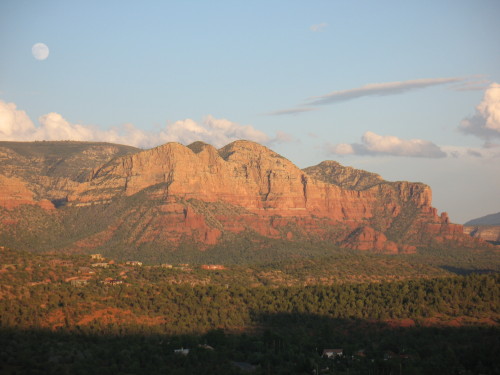
The Mermaid at moonrise, from Red Rock Loop Road

Honestly, you can find stirring scenery in Sedona, Arizona, without getting in a car and driving around. But spring is here, complete with wildflowers, busy birds, and blue skies, and one of the best ways to take it all in is with a scenic drive. Here are my favorites: 

1. Red Rock Scenic Byway
This 7.5-mile “All American Road” is Sedona’s main gateway, State Route 179 from I-17 through the Village of Oak Creek. Officially, Red Rock Scenic Byway begins at milepost 302, where SR 179 crosses Dry Beaver Creek. Like many “creeks” in Arizona, this one is a rocky wash except during spring runoff, but even when dry it’s delineated by tall cottonwoods and white-trunked Arizona sycamores. A couple miles further, the new forest service visitor center is an ideal place to stop to pick up trail maps and a Red Rock Pass, as well as take a long look at the panorama ahead. The view encompasses Bell Rock, Courthouse Butte, and other brilliantly colored cliffs.

In recent years, SR 179 has been widened to a divided four-lane highway, with scenic pullouts and ample trailhead parking. The designated scenic byway ends at milepost 310, near the celebrated Chapel of the Holy Cross, but the scenery doesn’t quit. SR 179 passes along Sedona’s “gallery row,” including the creekside shops at Tlaquepaque, before ending at “the Y,” a double-roundabout intersection with SR 89A.

2. Red Rock Loop Road
Travelers entering Sedona from the west via SR 89A can turn right at milepost 368 for Lower Red Rock Loop Road, the beginning of a scenic 7-mile long side trip that skirts the base of 4,899-foot Scheurman Mountain before circling back to rejoin the highway. Though a short section of the loop is gravel, the route is accessible to most passenger cars, depending on weather.

The loop road edges Oak Creek, where some of the Sedona area’s first settlers lived. The Schuerman homestead is preserved at Red Rock State Park, at mile 3 along the loop. The park offers great creekside birdwatching and easy hiking trails with great views. covered sandstone cliffs.

Don’t miss the side-trip to Crescent Moon Ranch picnic area and Red Rock Crossing. At the stop sign, turn onto Chavez Ranch Road and follow the signs. The spires of majestic Cathedral Rock soar above and reflect in the clear waters of Oak Creek, an inspiring scene said to be the most photographed place in Arizona.

The loop road climbs a series of hairpin turns before passing Red Rock High School and rejoining SR 89A. Dirt pullouts are good places to stop for breath-taking elevated views of Cathedral Rock and Courthouse Butte.

3. Boynton Pass Loop
A visit to Sedona’s backcountry, where you’ll find hiking trails and prehistoric ruins, begins by turning north on Dry Creek Road from SR 89A. Turn left at the next two T-intersections. (A right at the second T leads to the acclaimed Enchantment Resort and trailhead parking for Boynton Canyon, considered a vortex site.) The Boynton Pass Road (FR 152C) is paved to the Bear Mountain/Doe Mesa trailhead. Depending on weather conditions, most passenger cars can handle the dirt road beyond, which ends at FR 525, Red Canyon Road. Turn right, and you’ll come to a fork. To the left is the bumpy 4.5-mile route to Honanki ruins (high-clearance recommended). The 2-mile gravel road on the right leads to Palatki Heritage Site, home to a 900-year old dwelling built into the cliffs of Red Canyon by the Sinagua Indians. With a reservation, you can hike to the ruin overlook or take a guided tour through rock alcoves marked with thousands of pictographs and petroglyphs. Palatki and nearby Honanki are maintained by Coconino National Forest. To complete the loop after leaving Palatki, stay on Red Canyon Road for 10 miles until it connects with SR 89A.

BONUS: Schnebly Hill Road
Schnebly Hill Road winds up to the Mogollon Rim, following a historic route that early settlers used to reach Flagstaff, then a trip of 2-4 days. The views are amazing, but after the first mile, the dirt road is primitive and rocky. Unless you have a high-clearance vehicle, it’s best to see this one by signing up for a jeep tour or on foot via the Munds Wagon Trail, a 4-mile hiking trail that parallels the road. The trailhead has ample parking, picnic tables, and panoramic views of Uptown Sedona. Whether behind the wheel or on foot, stop to admire the Cow Pies, mounds of red sandstone (another vortex, say some) with outstanding views that take in Sedona and the Verde Valley. Schnebly Hill Road begins at the Oak Creek Bridge roundabout, next to Sedona Pottery.